HealthTech
Listening to Women's Health

A rhythm you already know
Most women already feel the rhythm. A week where sleep comes easily. A week where focus sharpens. A week where the body feels quieter. A week where everything seems turned up. These shifts aren’t imagined, and they aren’t a flaw in an otherwise steady baseline. They are the baseline.
The female body moves through layered cycles — circadian (24Hr cycle), monthly, reproductive, lifetime — and each one reshapes the physiology underneath.
A blood test captures one moment. An annual check-up captures maybe twelve moments across a decade. Neither matches the timescale on which a woman’s body actually works, which is why so much of what women have always known about their own bodies has lived outside the medical record.
Wearables change that, not by being more accurate than lab instruments — they aren’t — but by being always on. For the first time, the rhythm a woman has always felt can be traced in the quiet signal she leaves behind every night. The science of reading that signal is finally starting to catch up.
The four signals that matter
The signals a modern wearable can read continuously, and accurately enough to actually be useful, are surprisingly few. Four of them do most of the work for women’s physiology:
- Skin temperature — how warm the skin runs at night, measured from a wrist or finger sensor. Tracks ovulation, pregnancy, and fever with surprising sensitivity.
- Heart rate variability (HRV) — the tiny differences in timing between one heartbeat and the next, measured while you sleep. Reflects how relaxed or stressed the body is.
- Resting heart rate (RHR) — the lowest heart rate of the night. A slow-moving number that quietly adds up the day’s cumulative load on the body.
- Respiratory rate — breaths per minute during sleep. The least specific of the four, but also the most stable. When it shifts, it usually means something.
None of these are new to medicine. What’s new is measuring them every night, for years, on the same person. The useful information isn’t in any single number — it’s in how far that number drifts from a person’s own history.
Skin temperature — the clearest signal
Skin temperature is the most informative signal in female physiology because it tracks hormone levels so directly. Core body temperature rises by roughly 0.2–0.5 °C after ovulation — about a quarter of a degree — because progesterone gently warms the body. So the cycle has two temperature halves: a cooler first half (the follicular phase) and a warmer second half (the luteal phase). It’s the oldest known biological marker of the menstrual cycle, used long before digital wearables, when women tracked ovulation with a morning thermometer and a notebook.
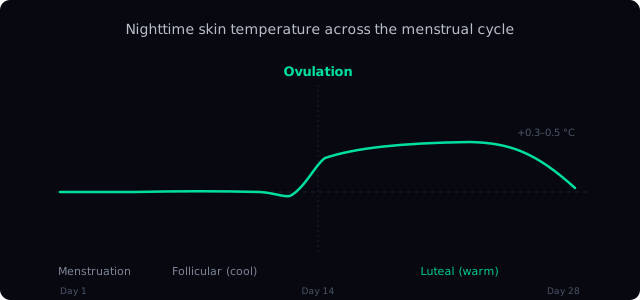
Wearables don’t actually measure core temperature. They measure skin temperature at the wrist or finger, which is a rough stand-in. Daytime skin temperature is mostly noise — clothing, room temperature, and activity all dominate the reading. Nighttime skin temperature, measured while the body is asleep and thermally settled, tracks core temperature closely enough to reveal the two-phase cycle, the day of ovulation, and even pregnancy within days of conception.
Oura has been the clearest researcher-operator in this space. Their published work shows that continuous nighttime skin temperature can identify the fertile window about as well as traditional methods like urine-based ovulation tests, without requiring anyone to remember to test at a specific time of day. The same sensor picks up the loss of the two-phase pattern in perimenopause, and the flattened or irregular temperature profiles seen in cycles where ovulation doesn’t happen and in conditions like PCOS.
HRV — the nervous system signal
HRV is the quiet signal underneath heart rate. No two heartbeats are exactly the same distance apart, and the size of that variation reflects how the nervous system is balanced — between the stress side (“fight-or-flight”) and the recovery side (“rest-and-digest”). Higher HRV generally means a more relaxed, well-recovered body. Lower HRV means something is loading the system.
In women, HRV shifts meaningfully across the cycle. A common HRV measure called RMSSD typically drops 10–20% in the second half of the cycle compared to the first, driven by the slight tilt toward the stress side that comes with rising progesterone. The body isn’t actually under stress — it’s just in a different gear.
This has a practical consequence. An HRV reading compared against a flat yearly average will systematically read second-half nights as unusually stressed, even when nothing is wrong. Good wearables now compare HRV against a cycle-phase-adjusted baseline rather than a flat one. That small correction turns HRV from a noisy monthly signal into a genuinely useful one.
HRV also drops during pregnancy, flattens in perimenopause, and can stay suppressed in PCOS and thyroid problems. It isn’t a specific test for any of these — but it’s a remarkably sensitive detector that something has changed.
Heart rate and breath — the slow view
Resting heart rate and respiratory rate are the most stable of the four signals. A healthy resting heart rate at night moves by only one or two beats per minute from one week to the next. When it drifts four to six beats above a person’s rolling average and stays there, it’s almost always tracking something real — luteal-phase elevation, an infection, heavy training, early pregnancy, or disrupted sleep.
In the menstrual cycle, resting heart rate rises 2–4 bpm on average in the second half, peaking in the days before a period. Respiratory rate follows the same pattern with a smaller swing — about 0.3–0.5 extra breaths per minute.
Neither number is particularly interesting on its own. Their value is in agreement. A temperature rise confirmed by a heart-rate rise and an HRV drop is a much more confident signal than any of them alone. That is the core logic of reading physiology from a wearable — no single measurement is diagnostic, but the joint pattern of several cheap measurements often is.
What Oura’s research actually shows
Oura has published more peer-reviewed research on women’s physiology from a wearable than most device makers, and the work is worth reading directly.
A 2022 study by Alzueta et al., in the International Journal of Women’s Health, followed 26 healthy women with regular cycles at home using the Oura Ring. The study confirmed the three physiological signatures that now underpin most wearable cycle tracking: a two-phase skin temperature pattern elevated in the mid-to-late luteal phase (p < 0.001), a luteal-phase rise in resting heart rate (p < 0.03), and a downward trend in HRV as progesterone climbed. The telling part: these physiological shifts showed up clearly even when the women didn’t feel different — their reported sleep quality and mood stayed steady. The body was tracking the cycle before the mind noticed.
Beyond that single study, Oura’s broader research has shown that continuous nighttime skin temperature can identify the fertile window with accuracy comparable to traditional methods, and that early pregnancy produces a distinctive signature — sustained temperature elevation together with elevated resting heart rate — that often shows up several days before a missed period would prompt a home pregnancy test. Read in reverse, the same patterns flatten and become irregular through perimenopause, giving wearables a continuous view of the transition that clinical visits can’t match.
The honest framing: wearables aren’t diagnosing anything. They’re producing rich, continuous, long-term data that lines up with physiological states historically measured by less convenient means. That is a real contribution.
Beyond the cycle
The same four signals carry meaningful information well beyond reproduction itself. The underlying reason is simple: heart rate, thermoregulation, and nervous-system balance respond to hormones, illness, training load, and systemic stress using the same vocabulary. The cycle signature is one dialect of a broader language, and once you know how to read it, the other dialects start to make sense too.
Pregnancy
Pregnancy produces what may be the clearest signature a wearable can pick up. A 2025 large-scale analysis of more than 10,000 pregnancies tracked with the Oura Ring (JMIR mHealth and uHealth) mapped the physiological trajectory from conception through postpartum. Skin temperature began rising by gestational week 4 and reached about +0.3 °C above baseline by week 9. Resting heart rate lifted by roughly 4 bpm by week 5 and climbed steadily to more than +10 bpm by week 32. HRV mirrored the opposite path, falling more than 15 ms below baseline by mid-pregnancy. Respiratory rate rose by about one breath per minute, peaking around weeks 8–9.
The practical consequence: temperature moves first, and it moves earliest. That is why several wearables now flag likely early pregnancy days before a home test would — not by detecting hCG, but by noticing that the luteal-phase temperature elevation hasn’t come down when it should.
Perimenopause
Perimenopause unfolds across years, which is exactly the timescale a wearable is suited to. The two-phase temperature pattern breaks down as ovulation becomes irregular. Night-to-night variability rises. Hot flashes introduce sharp nocturnal temperature and heart-rate spikes that weren’t there before. HRV tends to decline, and sleep fragmentation worsens.
A 2025 scoping review (Decoding female physiology) synthesised 36 studies on digital health tools across the menstrual cycle, perimenopause, and menopause, and the picture that emerges is that point-in-time hormone panels miss most of what a wearable sees continuously. Laboratory work cited in that review reports body-temperature excursions of roughly 1.1 °C during perimenopausal hot flashes — large enough that continuous skin temperature from a wrist or finger can trace them in sleep. The algorithms for automatic hot-flash detection are still early, but the direction is clear.
Conditions beyond reproduction
PCOS and anovulatory cycles. In women with polycystic ovary syndrome, the luteal temperature shift is often delayed, blunted, or missing entirely — the signature of ovulation simply isn’t there. Research comparing continuous wrist skin temperature against traditional basal body temperature (Zhu et al., Journal of Medical Internet Research, 2021) found that wrist readings detected ovulation with markedly higher sensitivity than BBT did (0.62 vs 0.23). A wearable can’t diagnose PCOS, but it can show that the usual luteal signature is missing — which is useful information to bring to a gynaecologist.
Thyroid problems. Thyroid hormone has a direct chronotropic effect — too much pushes heart rate up, too little slows it down. Two wearable-based studies show how clearly this comes through in day-to-day tracking. A 2018 study in JMIR mHealth and uHealth found that resting heart rate from a wearable tracker reliably followed the course of thyrotoxicosis treatment. A 2021 study in Endocrinology and Metabolism showed the inverse for hypothyroidism — wearable-derived heart rate predicted thyroid function, and even free T4 levels in well-controlled patients. Wearable data isn’t a thyroid test, but persistent, unexplained shifts in resting heart rate are a hint worth investigating.
Autoimmune flares. The clearest recent evidence comes from rheumatoid arthritis. A 2025 study in Scientific Reports equipped people with RA with an Apple Watch, Fitbit, or Oura Ring and tracked them through flares and remissions. Daily heart rate and resting heart rate were consistently elevated during flare periods compared to remission, and circadian features of HRV distinguished the two states. Strikingly, these physiological shifts were detectable up to four weeks before flares became clinically apparent — long enough that some people with RA now use their own wearable trends as an early-warning system to pace the week before symptoms arrive.
What wearables still can’t see
Being honest about the limits matters as much as being clear about the capabilities.
A wearable can’t measure hormone levels directly. Temperature is a rough proxy for progesterone, not a measurement of it. Anything that depends on knowing the actual concentration of estrogen, FSH, LH, or thyroid hormones still needs a blood test.
A wearable can’t detect endometriosis, ovarian cysts, fibroids, or reproductive cancers. These conditions either leave no trace in the four signals or leave one so vague it’s impossible to tell apart from normal variation.
A wearable can’t reliably predict PMS severity or mood. Claims in that direction are mostly marketing — the physiological signature of mood is too individual, and too tangled up with sleep, alcohol, and social context, to be a clean signal from a wrist sensor.
A wearable can’t replace the clinical relationship. Continuous data is a supplement to good care, not a substitute for it. The most useful outcome, for most users, isn’t self-diagnosis. It’s walking into a doctor’s office with a year of trended data that makes the conversation measurably better.
That, in the end, is the point. The female body has always had a rhythm. The difference now is that, for the first time, it’s possible to listen to it continuously — and the science of what to do with that listening is only just beginning.